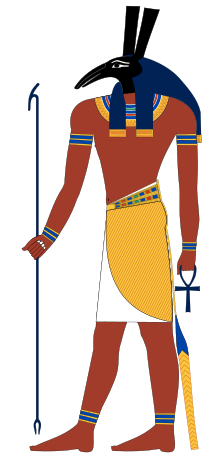
TYPE: God of chaos and adversity.
ORIGIN: Egyptian
KNOWN PERIOD OF WORSHIP: from 3000 BCE or earlier to the end of Egyptian history circa 400 CE.
SYNONYMS: Set, Setekh, Setes, Sutekh, Suty.
CENTER(S) OF CULT: chiefly a sanctuary in Upper Egypt at Ombos-Naqada, but also in Lower Egypt, in the northeast of the Nile delta.
ART REFERENCES: sculptures, stone reliefs, wall paintings, etc.
LITERARY SOURCES: Pyramid Texts, coffin texts, Book of the Dead, Etc.
INFORMATION: Seth is a deity who generally represents hostility and violence, but who has also claimed considerable respect. His parents are Geb and Nut and his fellow siblings include Isis, Osiris and Nephthys, who at time is also seen as his consort. More typically he is linked with Semitic war goddesses including Anat and Astarte. Legend has it htat he tore himself violently from his mother's womb. He is depicted in human form with the head of an animal that seems to bear a faint similarity to an aardvark with erect ears and a long curving snout. He is also depicted wholly in animal form, in which case the beast bears no real similarity to any living creature, but has a stiffly erect tail. Other animals symbolizing the god include the oryx, pig, boar, and the hippopotamus when it it a disruptive element of the river. Seth is also represented by the crocodile (see Geb).
Sometime during the middle of the third millennium, in the II Dynasty, there was a break with the tradition whereby the kings of Egypt were linked with the god Horus. The falcon symbolism of Horus was replaced with that of the creature of Seth. Several Egyptian rulers followed his cult closely. Tuthmosis III in the XVIII Dynasty, for example, titled himself "the beloved of Seth".
In the Osirian legend first recorded in the Pyramid Texts adn later popularized and embellished by the Greek writer Plutarch, Seth is the jealous adversary of his brother Osiris (See Osiris for details). Later he fought an eighty-year war of attrition with the son of Osiris, the falcon god Horus (see also Horus). During this time, the implication remains that he was favored by the sun god and only forceful wrangling resulted in victory falling to Horus as rightful overlord of the two Egyptian kingdoms. A separate mythology credits Seth with defense of the Sun god Re as he is about to be swallowed by Apophis, the perennially hostile serpent god of the underworld. The so-called "Book of the Dead" accounts Seth as the "lord of the northern sky" who controls the storm clouds and thunder.
Rameses II, in a treaty with the Hittites, implied a fusion of Seth with the Hittite storm god Tesub.